Showing posts with label teaching. Show all posts
Showing posts with label teaching. Show all posts
8.22.2014
More About the Master of Arts in Teaching Program at AMNH - Videos!
I stumbled on these videos today and thought I should post them. What they present about the MAT program is pretty close to my own experience.


8.11.2014
Three weeks of Co-teaching

The following is a blog post that I wrote in Moodle. Moodle is a learning management system and no one, outside of my classmates, my instructors, and maybe the MAT program administration, can see these posts we make and the comments to those posts. I do not like Learning Management Systems, but I have used them as a student, I have used them as an instructor, and my children have had to use them, so I can see the efficacy of using one. I just don't like them. So I am freeing some of the content that's hidden away. This post was more of a comment to a thread on class and privilege that I felt compelled to respond to and then felt I wanted to share with this blog.
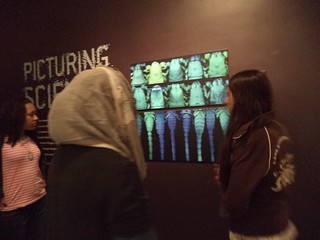
About the socio-economic dynamics much discussed here…I didn’t really see it. I mean, I did not see it being a problem in the learning environment. Sure, there were the kids who were all aflutter about going to one of the other kid’s country house. (It was probably in or near Poughkeepsie, BTW.) It was only the girls who got to go, so I felt badly for the boys. At least one of the girls was not going ("my mom said we have something to do that day") and I felt badly for her, too. But, frankly, I don’t think I’d want my daughter going (by limo!) to a country house so she can feel like she has a life that is less-than or more suck-ish than this kid’s life.

So much of what a kid goes through in life is dependent upon the zip code he or she is unlucky (or lucky) enough to be born into and those economics are passed along through the generations. The pull-yourself-up-by the-bootstraps American ethos is a myth, IMO. We need to treat all kids like they are born into the high-rent district and teach like all kids belong in a program like Lang. That is our challenge.

7.03.2014
Carts in the Hall and Posting in a Learning Management System

We finished up our first segment of curriculum and pedagogical chunk of our MAT program…working on carts in the halls. Carts are an assemblage of artifacts or rock samples or minerals from a hall that are setup for interacting with museum visitors. It’s a “please touch” station. We, as MAT students, worked in groups of three on a cart for four hours at a stretch in one of these halls: Gems & Minerals, Mexico & Central America, New York State Environments, African Peoples, and Planet Earth. We did this on seven different days.

One of the great things about this program at this museum is that, because AMNH is a world-renowned natural history museum, people come to visit it from all over the world. On the carts, we got so many vacationers/visitors from everywhere and it challenges a person to try to convey knowledge when there is no common language. This, too, is practice for our school residency and our futures as teachers. A large percentage of students in NYC are not English-language learners.

So, on to the Learning Management System. I am working towards a teaching credential to teach earth science in the New York state public school system. Our first class in the MAT program has been mostly on-line with a small chunk of face-to-face time. I am not opposed to on-line education but I can pretty much guarantee that I will not be doing any on-line teaching with my students so it’s weird. The LMS is the Moodle platform and, though this installation of Moodle is better than the one I had to use at Bard last semester, it is still a closed system. We’re all doing and saying some interesting things but only the 15 of us plus the 2 (or is it three?) instructors get to see it. I am not a fan of Moodle or the LMS environment and only know from being on the teaching end is that it makes classroom management much easier to ask students to upload their document by X time and date, they get an email confirmation, teacher knows they uploaded it and at what time (is it late?), teacher can see how many posts the student did to the forum, and then teacher can do the grades in Moodle. Ugh. It is pretty clunky. Classroom Management and Learning Management make me cringe.
But the class, even though I’m nagging about it being on-line, has been pretty interesting. I’ve had to be self-directed, but the way the course is set-up, we all can follow paths that we are interested in taking, topics we wish to investigate and write about. Plus some of the assignments have involved visuals like creating graphics and use of Google Maps. The face-to-face aspect of the course is preparation for how we will teach this topic in our future Earth Science classroom.
First month down, 14 more to go!
5.15.2014
Graduate School!

I am starting a new adventure very soon. On June 2, I will again be a graduate student, this time in the Master of Arts in Teaching program at the American Museum of Natural History. This is very very exciting for me and I’ll be posting about the experiences since, after all, I am from Poughkeepsie, and I will be traveling down to the City for the program.
In a nutshell, the program is 15 months of intensive study and teaching experiences that all lead to a New York state teaching credential in grades 7-12 Earth Science teaching. There are two summers and a school term over the 15 month period and the two summers are spent in the hallowed halls of AMNH, working with collections, curators and educators on mastering the art of informal learning. The school term, of course, starts in the Fall, and I will be placed in residency at a school affiliated with the MAT program. In the Spring semester, I’ll be placed a different affiliated school so that I get exposed to a different aspect of teaching. At the end of the MAT program, with my new teaching credential, I will be employed as a teacher in a high needs school somewhere in New York. Somewhere close to my Poughkeepsie home is what I’m hoping for!
A teaching program at a museum is not so common. I am in the 3rd cohort of students in the MAT program. This video will give some background.
My education started soon after I heard of my acceptance into the MAT program when I was invited to come to two different talks at the Museum. On April 9 I had the great fortune of listening to Neil deGrasse Tyson speak at a public lecture at the AMNH. For the 0.0004% of the population who does NOT know who Tyson is, he is the Director of the Hayden Planetarium at the AMNH. Plus, he's the host of the newly updated Cosmos: A Spacetime Odyssey series on FOX. Tyson spoke for about an hour and then answered questions, all on the making of Cosmos. I went into the talk thinking it would be about the Cosmos and astrophysics and astronomy, but no, it was much more down-to-earth. Thankfully!

During his talk,Tyson showed what he called "a 1,000 slides because it was all novel!" It was all behind the scenes, green screen shots, and LOT'S of selfies. He had a very warm and regular-guy approach. There he was getting his hair done and dyed at The Blade barber shop. Here he is in California, eating his first In-N-Out Burger. "You see that long line of cars behind me in this shot? I said 'I'm not going to wait in a car to get food that I'm going to eat in a car!?! I've got to get out of the car for some time in the day!!' We walked in and there was no one waiting in line. They were all in their cars!" He showed many shots of food. And wine. All highlighting the fact of the novelness of this whole enterprise. (The photo to the left is grabbed from @gmberrow and though I did not take this shot, Tyson said that someone asked him "Dr Tyson, why are you picking up a white baby in that scene in Cosmos?" Tyson told us that he responded with: The host is black, OK?! We got this!)

Tyson graciously praised the gaffer and the grips, "the hard-working people doing their thing, they're the ones making a film or TV show happen. Their names go by so fast at the end of the film that you never know that without them the movie could not be possible.” He showed his makeup artist, his wardrobe person, his teleprompter person. He showed himself with glued-on stubble on his face "I can't grow facial hair!" It was a spectacular start to my education. (This one to the right is by @katmcsplat)
On May 12 I went to the second talk, this time with my son as my plus-1, and got to sit in the Hayden Planetarium and hear Katherine Freese talk about Dark Matter and Cosmic Cocktails. I was a little blown away and in over my head. My son said, “I think I might have sort of understood ¼ of that.” I didn’t tell him that I would put myself at about an ⅛. But the event was packed with people and this was the first time for me going to the planetarium (I’d been to one in L.A. as a young person.) I should have watched this video ahead of time, you know, flipped the classroom.
The photo of the front of the AMNH at the top of the page is by Marjorie Lipan with a CC license.
Subscribe to:
Posts (Atom)