Pages

Showing posts with label MAT. Show all posts

7.10.2015

Orchard Beach at Pelham Bay Park

We met bright and early at Orchard Beach. The day was very warm. You drive through the sprawling Pelham Bay Park - with horse stables and bike paths and picnic benches - to get to the beach. Parking is $7. The field trip was led by George Harlow and we walked north along the beach towards Twin Island.


This field trip provided another view of the local NYC geology, with all its complexity. Because we were not given a field trip guide ahead of time, I looked up some information about the site and what's there. Here are the links: Bedrock Geology of New York City: More than 600 m.y. of geologic history and 6. Pelham Bay Park (USGS). Don't you love going into the field knowing what you might find? I do.

Here's what I saw: the Bronx section of the Fordham Gneiss, loads of folding, partial melting (we've seen that on all stops thus far), a patch of garnet sand, tourmaline, epidote, beryl, biotite and muscovite (sometimes intergrown with each other) and kyanite blades (see below)! Sillimanite? No, I don't think so.

And a dinosar:


Bring on the Black Rock Field Trip!! That'll be all week, the week of July 27. Just like old times and field camp at CSU Hayward in the Sierra. Ha!

7.02.2015

Field Trip to Inwood Park

Today was more like a real field trip. Though we met in upper Manhattan and walked and looked at a great outcrop right in a community, we scrambled around in mostly lush Inwood Park, poison ivy and all.

The field trip leader was George Harlow, Curator, Department of Earth and Planetary Sciences at AMNH. We ambled around, first in the city, along Cooper Street and then into Isham Park. Then we went to Inwood Park. The aerial view map below is where we went in Manhattan, but not the Bronx. As you can see in the simplified geologic map and cross-section below, the geology is quite complex. It is also almost completely covered with vegetation, which is very often poison ivy. It is nuts. I longed for a western or southwest field location where all the outcrops are exposed.


The first very cool thing we saw was a great example of boudinage. See the image below (try squinting - they're there). The boudins were in the Inwood Marble and are a result of a more resistance or rigid layer (probably proto-sandstone) within a more plastic layer (possibly proto-limestone) undergoing compression.

We saw some good-sized garnets with eye-shaped feldspar growths:

Tramping into the Inwood Park, we saw "potholes," which I have seen elsewhere but did not know that they were created from glacial meltwater, with a rock or two swirling around and down, carving out a deep hole. The opening on this one - in Manhattan Schist - is about a 2-foot diameter.

By walking north and crossing the Henry Hudson bridge, we ended up in the Bronx, looking at the Fordham Gneiss. At this outcrop, we saw more garnet, amphibole, pyrite, and ptygmatic folding in the gneiss. A very good trip, all in all, and we were finished by 2pm.

7.01.2015

Summer Practicum Activities - #NYCgeology along 5th Avenue

It's all starting now! My summer will be spent doing research in astronomy at the museum and going on field trips with curators and post-docs affiliated with the MAT program.

Today, I went on a "field trip" to see  some of the building stones of a part of Manhattan, New York. Led by Denton Ebel, the trip went from the lower Central Park area to 5th Avenue and 45th Street. We saw an array of rock types, many of which came imported from Italy. Building stones are a great way to teach geology when you a) don't have a budget for a real field trip and b) don't have access to real geology right in the neighborhood.

Here are some shots from inside the Apple Store, where we saw the "special" rock that Apple loved so much that they purchased they whole mine so they could brand their stores. We also saw some lovely partial melting migmatites.


6.11.2015

Exhausted!

I met one of the new MAT students, a Cohort 4 student, the other day. She bounded up to me and said, "hey, I've been meaning to talk with you. I found your blog and that was great, but it just stopped." She told me she was worried that meant something like, I hurt myself, I gave up on blogging, or I was overloaded in the program and it was too much. She was dying to know what happened and what she had gotten herself into! Here's the scoop...I have not had one single minute to do too much more than stay on top of my AMNH school work (lot's of it!), go to my school residencies (Monday to Thursday from September to mid-June), commute an hour and a half (minimum) each way, everyday, and see my family once in awhile. ha ha I live with them but they usually just see the back of my head while I'm working away on my school work and class prep. There is no time to blog! Sorry 'bout that. If I can muster the strength, I will try to write an update about my experiences. There have been a lot of experiences!

8.22.2014

More About the Master of Arts in Teaching Program at AMNH - Videos!

I stumbled on these videos today and thought I should post them. What they present about the MAT program is pretty close to my own experience.


8.11.2014

Three weeks of Co-teaching

We wrapped a three-week stint of co-teaching in the Lang Science program at the Museum. Lang is a unique program that brings kids from all around New York City to learn a science topic (or multiple topics) over three weeks. But it's not just one and done. There's an application process and the program starts when kids are going into the sixth grade and they stay with it until they graduate from high school. Every summer. For seven summers. Wow! Not only that. The Langsters commit to coming to the Museum for 18 additional Saturdays throughout the school term. That is a lot of science and a lot of love for science learning on the part of the young people in Lang. The MAT program is incorporated into the Lang program by having us co-teach lessons (that's me teaching about chemical weathering and stratigraphy), guide Lang students on research design, work with the lead Lang instructor on activities and whatever other way we can see ourselves jumping in to help out.

The following is a blog post that I wrote in Moodle.  Moodle is a learning management system and no one, outside of my classmates, my instructors, and maybe the MAT program administration, can see these posts we make and the comments to those posts. I do not like Learning Management Systems, but I have used them as a student, I have used them as an instructor, and my children have had to use them, so I can see the efficacy of using one. I just don't like them. So I am freeing some of the content that's hidden away. This post was more of a comment to a thread on class and privilege that I felt compelled to respond to and then felt I wanted to share with this blog.

So, the week with the Lang 7th graders has come and, sadly, gone. What a wonderful group! I will miss them and will be more than glad to take a position as a middle school teacher.

About the socio-economic dynamics much discussed here…I didn’t really see it. I mean, I did not see it being a problem in the learning environment. Sure, there were the kids who were all aflutter about going to one of the other kid’s country house. (It was probably in or near Poughkeepsie, BTW.) It was only the girls who got to go, so I felt badly for the boys. At least one of the girls was not going ("my mom said we have something to do that day") and I felt badly for her, too. But, frankly, I don’t think I’d want my daughter going (by limo!) to a country house so she can feel like she has a life that is less-than or more suck-ish than this kid’s life.

OK, that aside, I feel like almost all of the learners spoke up in Lang 7th grade. I did not see the "rich" kids speaking more than the "financial aid" kids. (And I did not see an economic divide at all in the 9th to 12th research group.) I mean, how do we really know who has money and who doesn't? I did not get that list. We could make major assumptions, but perhaps the kid who talked about walking to the bottom of the Grand Canyon was not really bragging, she might have been lying or she might have been a college professor’s child. Or her family is middle class and they know that trips like that are good for kids' development.

So much of what a kid goes through in life is dependent upon the zip code he or she is unlucky (or lucky) enough to be born into and those economics are passed along through the generations. The pull-yourself-up-by the-bootstraps American ethos is a myth, IMO. We need to treat all kids like they are born into the high-rent district and teach like all kids belong in a program like Lang. That is our challenge.

What is clear is that, if I imagine myself teaching in the high-needs school in my neighborhood, I will see in my classroom kids mostly from low-income families. Some of them will be homeless. But there are pockets in my area, in that school district, that are middle class and upper middle class. Some of those kids will go on summer trips to The Shore or will have passports with stamps in them, but some will have never left Poughkeepsie. I want all of them to feel like they can raise their hand, add their thoughts and observations, and know in their hearts that I think that what they have to say is important and matters.

7.26.2014

Some Photos, What's Been Going on at the Museum

I've gotten to see and do a lot of interesting things at AMNH so here are just a few photos of those things.
We got the inside look at he AMNH Library.
They have a large rare book collection (but I didn't see it). 
Also in the AMNH Library, an extensive collection
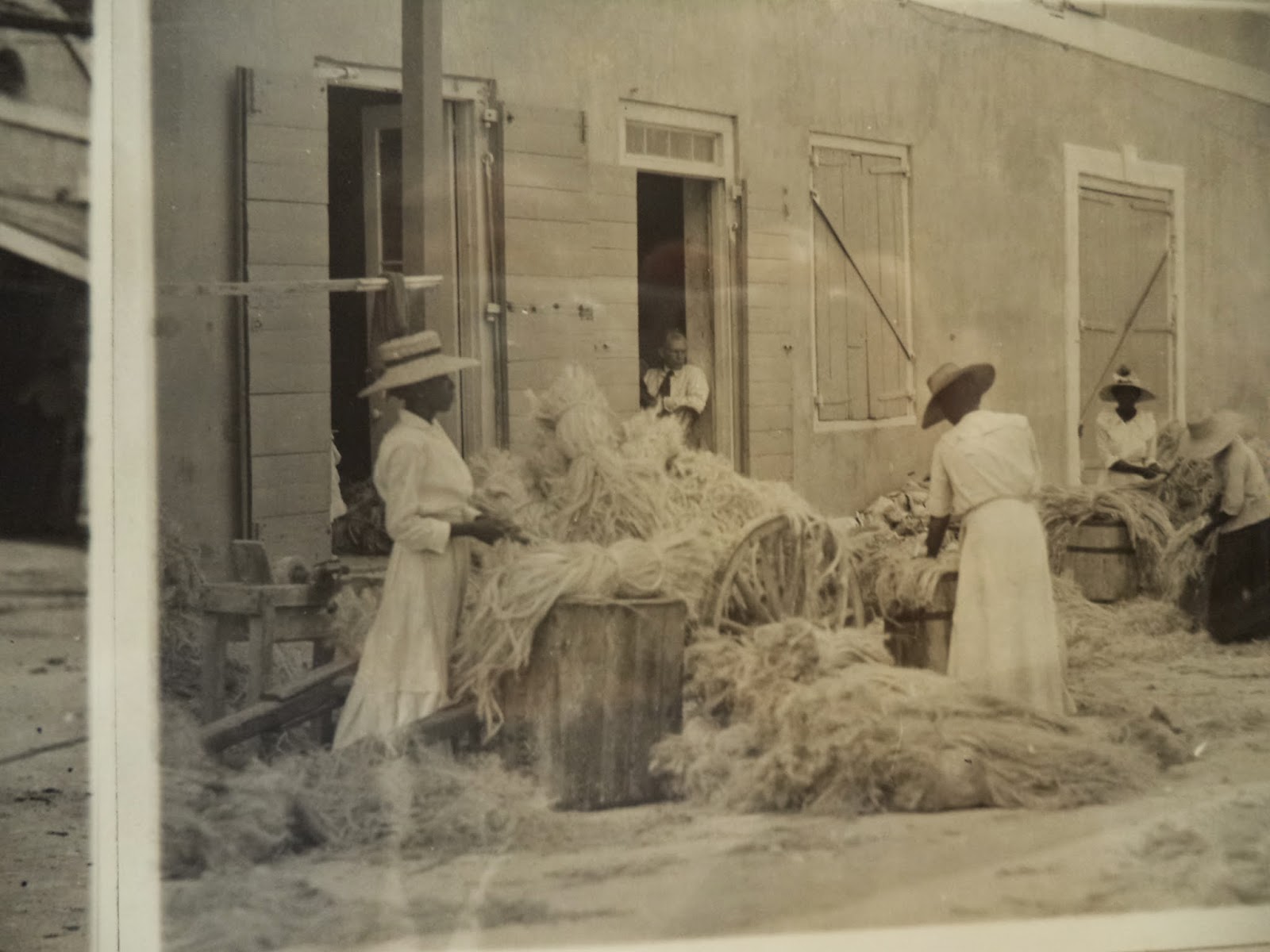
of paper photographs like this one. This photo
was taken in Barbados in 1919.

Behind the scenes with an ichthyologist.
These are two coelacanths.
Some skinny, long fish of some sort.


This is one of the classrooms. Our regular Davis classrooms
have been used for summertime teacher professional
development workshops.

Now we're working with a summer program called Lang, and
the project for the next two weeks will be to study Cnidarians or
Sea Anemones using a CT scanner.
Here a Lang student is getting a little background
information on Cnidarians in the Hall of Biodiversity.
And here are some preserved sea anemones and a jellyfish
waiting for lab investigation.
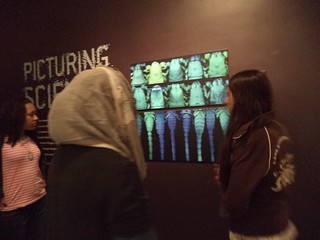
Next up, more on Lang which is our second time working with museum visitors but Lang is a summer institute for middle and high school students focused on learning science. We will be using the CT scanner, the one used in the Picturing Science exhibit, and making 3D models of sea anemones. Well, the students will be!

7.03.2014

Carts in the Hall and Posting in a Learning Management System

Kids in the Hall? No, Carts in the Hall

We finished up our first segment of curriculum and pedagogical chunk of our MAT program…working on carts in the halls. Carts are an assemblage of artifacts or rock samples or minerals from a hall that are setup for interacting with museum visitors. It’s a “please touch” station. We, as MAT students, worked in groups of three on a cart for four hours at a stretch in one of these halls: Gems & Minerals, Mexico & Central America, New York State Environments, African Peoples, and Planet Earth. We did this on seven different days.

This was our first dip into teaching with a museum collection or using informal teaching. We were shown how to use inquiry-based discussion with the visitors…’what do you think it is?...how do you think they would use this?...do you think you might have this in your home?’ so that it was setup as a discussion rather then a one-way stream of us, cart people, feeding answers to them, the museum patrons. This inquiry-based style of teaching reminds me of when I worked at a summer camp the past three summers. Camp kids come in knowing a lot already, you guide them, using their brains, to new places to understand new concepts. It was like that on the carts. But with folks from 3 years old to over seventy. And just like camp, these visitors are there because they want to be. The visitors can leave your cart at any moment or not even come over to your cart. It’s a free choice situation.

One of the great things about this program at this museum is that, because AMNH is a world-renowned natural history museum, people come to visit it from all over the world. On the carts, we got so many vacationers/visitors from everywhere and it challenges a person to try to convey knowledge when there is no common language. This, too, is practice for our school residency and our futures as teachers. A large percentage of students in NYC are not English-language learners.

Carts were fun. Next informal learning session will be with a group teens who are in a summer enrichment program. I do not know exactly what we will be doing with those young people, but I will report back. So far I know we are engaged with a lot of team-teaching experiences. I haven’t had to fly solo yet and I really appreciate that.

So, on to the Learning Management System. I am working towards a teaching credential to teach earth science in the New York state public school system. Our first class in the MAT program has been mostly on-line with a small chunk of face-to-face time. I am not opposed to on-line education but I can pretty much guarantee that I will not be doing any on-line teaching with my students so it’s weird. The LMS is the Moodle platform and, though this installation of Moodle is better than the one I had to use at Bard last semester, it is still a closed system. We’re all doing and saying some interesting things but only the 15 of us plus the 2 (or is it three?) instructors get to see it. I am not a fan of Moodle or the LMS environment and only know from being on the teaching end is that it makes classroom management much easier to ask students to upload their document by X time and date, they get an email confirmation, teacher knows they uploaded it and at what time (is it late?), teacher can see how many posts the student did to the forum, and then teacher can do the grades in Moodle. Ugh. It is pretty clunky. Classroom Management and Learning Management make me cringe.

But the class, even though I’m nagging about it being on-line, has been pretty interesting. I’ve had to be self-directed, but the way the course is set-up, we all can follow paths that we are interested in taking, topics we wish to investigate and write about. Plus some of the assignments have involved visuals like creating graphics and use of Google Maps. The face-to-face aspect of the course is preparation for how we will teach this topic in our future Earth Science classroom.

First month down, 14 more to go!

6.08.2014

First Week....Exhausted!

Why am I exhausted?! Because I have built my adult life around the ethos "live close to your work." And, after escaping Los Angeles, I always (but for one brief-ish exception) lived close enough to work or school that I could walk, ride a bike or had a short car drive. I'm not used to this lifestyle! Now, I have a LONG train and subway ride but it's for a duration that I think I can handle, 15 months. But for now, wow, I am a tired woman when I get home to Poughkeepsie. This has been my week at the Museum.

The commute: If I hit it just right, I can make it door-of-my-house to door-of-the-Museum in 2 and a half hours...in the morning. At night, it's longer. Hrumph. But I  have built-in exercise (walking from subway stop to Museum or riding bike from house to Metro North station) so there's that. And that mifi let's me work on the train.
Team Building: Our teacher candidate cohort (that's them above plus a couple of instructors) had an afternoon in Central Park where we worked on learning each other's names and team building. The upshot...we are a team...collaborate! Good to get that out there early because, though I have been out of the being-a-student game for a awhile, I hear that learners these days can get kind of competitive and suffer from grade-anxiety. Plus we got to scramble around Central Park.


Seminars: Over the summer, we will meet with different Museum curators who will give us an exposure to their area of expertise. This week was rocks and minerals. Looking forward to seminars on something I know nothing about like...the solar system!

Laptop: We each got a Mac. We will have to return it at the end of instruction.

Chancellor's Day: A day of NYC science teacher professional development at the Museum that all of we teacher candidates got to participate in.  I got to learn a bit about Common Core and Next Generation Science Standards. Also, I heard an interesting panel on encouraging girls to pursue the sciences. What pleased me about the talk and panel was that all teachers were there, male and female. What I found from my technology conference days is that these sorts of gyno-centric panel discussions are mostly women talking to ourselves.

First class - Solar System: This course is a mostly on-line class and the curriculum was developed by geologist Denton Ebel and Astrophysicist Neil deGrasse Tyson. There is some face-to-face time each week with one of the three faculty members teaching the course. I need it. I know nothing about this topic. See Seminars above.

School visits: Our education involves teaching in in-school residency for the school year and we are visiting the four schools that are part of the MAT program. We visit them all to get a sense of each and then we request the schools for our residency training - a different school for each half of the school year. I saw two schools this past week (one in Yonkers and the other in the Bronx) and I can't tell one from the other in terms of, oh, this one would be way better than that one, so at this point, I'm going to request the schools closest to me to try to reduce my commute. See The commute above.

Circle Line tour: We wrapped up our very full week with a boat trip around Manhattan on the Circle Line. Before heading out, at AMNH we got a brief geologic overview of Manhattan so we had some geomorphic items to keep our eyes open for. The day was stunning. I love viewing Manhattan from this water vantage but what I enjoyed the most was seeing all the bridges.

Week number 2, let's go!

6.02.2014

First Day (Back) in Grad School

Up early! Got my new backpack, my Mifi hotspot (Verizon Jetpack) and my monthly Metro-North ticket ready for my first day as a Master of Arts in Teaching student at the American Museum of Natural History.  At this point, I'm planning on taking the train down every day, Monday to Friday, while doing the museum-residency part of my education.